
What conditions are expected?
An Environmental Profile records the conditions your organisation has chosen for a collection, room, case or other context.
About Environmental Profiles →Planned monitoring
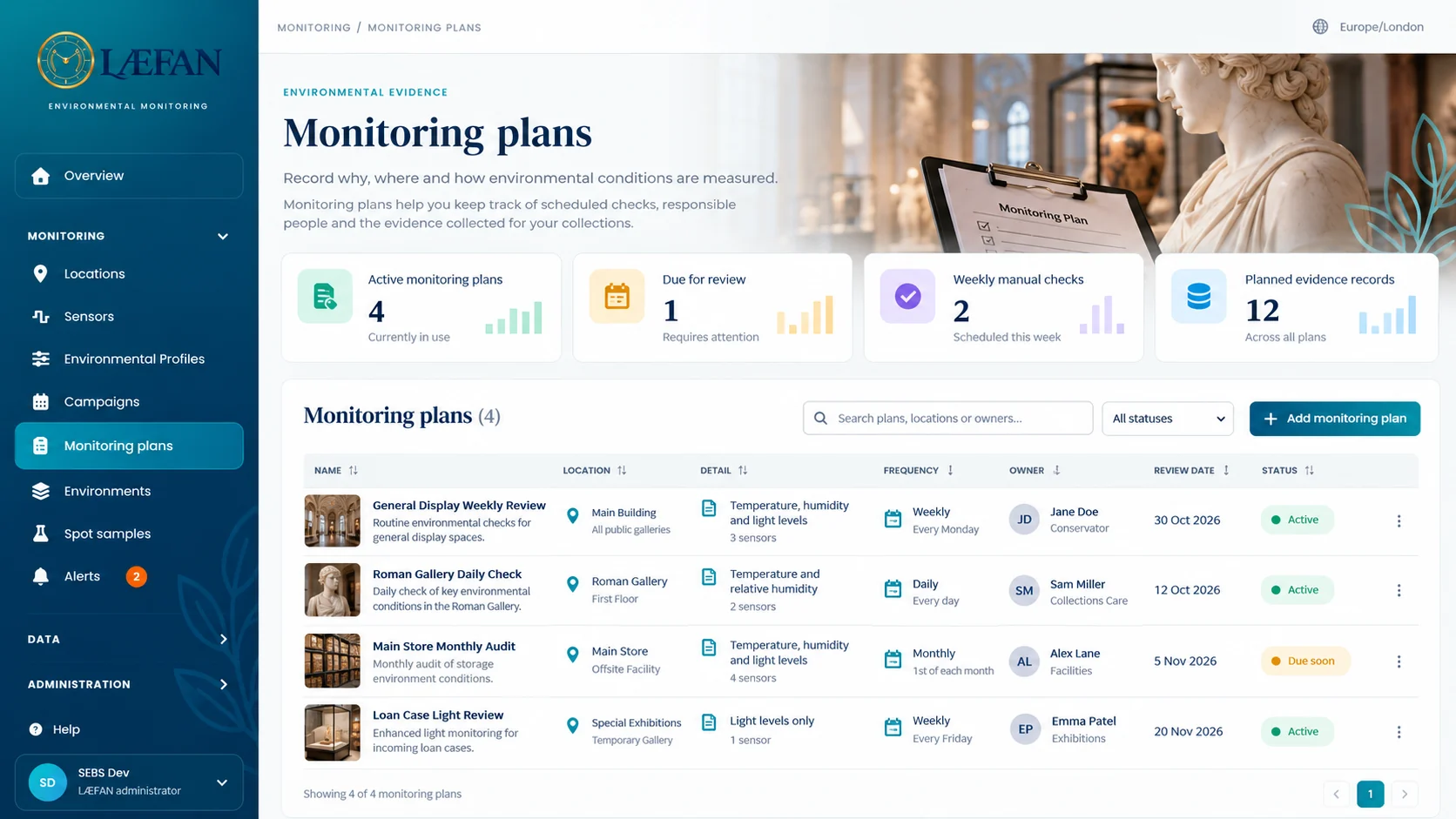
A Monitoring Plan brings together what needs checking, where it applies, how often it should happen and who is responsible, then keeps the resulting evidence close to the environmental record.
Keep the jobs clear
These parts of LÆFAN work together, but each has a different job. Keeping them separate makes the environmental record much easier to understand later.
An Environmental Profile records the conditions your organisation has chosen for a collection, room, case or other context.
About Environmental Profiles →A Monitoring Plan records the routine: what is measured, how it is checked, how often, who is responsible and what evidence should be kept.
A Campaign gives a defined period of context for a loan, exhibition or investigation without replacing the normal monitoring underneath it.
Explore Campaigns →A plan in action
Follow a typical routine for a gallery. The detail can change by collection and setting, but the structure stays understandable.
A plan should make sense to someone who was not there when it was created. Give the routine a clear purpose and attach it to the gallery, store, display case or monitoring point it belongs to.
One routine, different kinds of evidence
A useful plan does not ask staff to manually inspect every incoming reading. Continuous sources can provide the environmental history, while planned checks give people a clear moment to review conditions, add observations and record anything that needs follow-up.
Useful work, not paperwork
The practical value is not simply having a plan stored in the system. It is giving staff a clear routine and leaving behind evidence that the agreed monitoring was actually carried out.
That also makes missed or late checks visible instead of quietly disappearing when the next date arrives.
Read the monitoring & evidence guidance →Review the plan itself
Collections move, exhibitions change, sensors are replaced and responsibilities shift. A review date gives the team a regular prompt to confirm that the plan still reflects what is actually happening.
What becomes evidence
Monitoring Plans are most useful when the work they generate remains connected to the readings and context around it.
Show whether the agreed routine happened and who completed it.
Add a one-off measurement or observation without replacing continuous data.
Explore Spot Records →Keep relevant environmental excursions visible during the monitoring routine.
Alerts & response →Keep a record of when the plan was reviewed and why it changed.
The result is a clearer evidence trail: what was expected, how it was monitored, whether the checks happened, what changed and what was recorded afterwards.
Explore Reports & Evidence →