
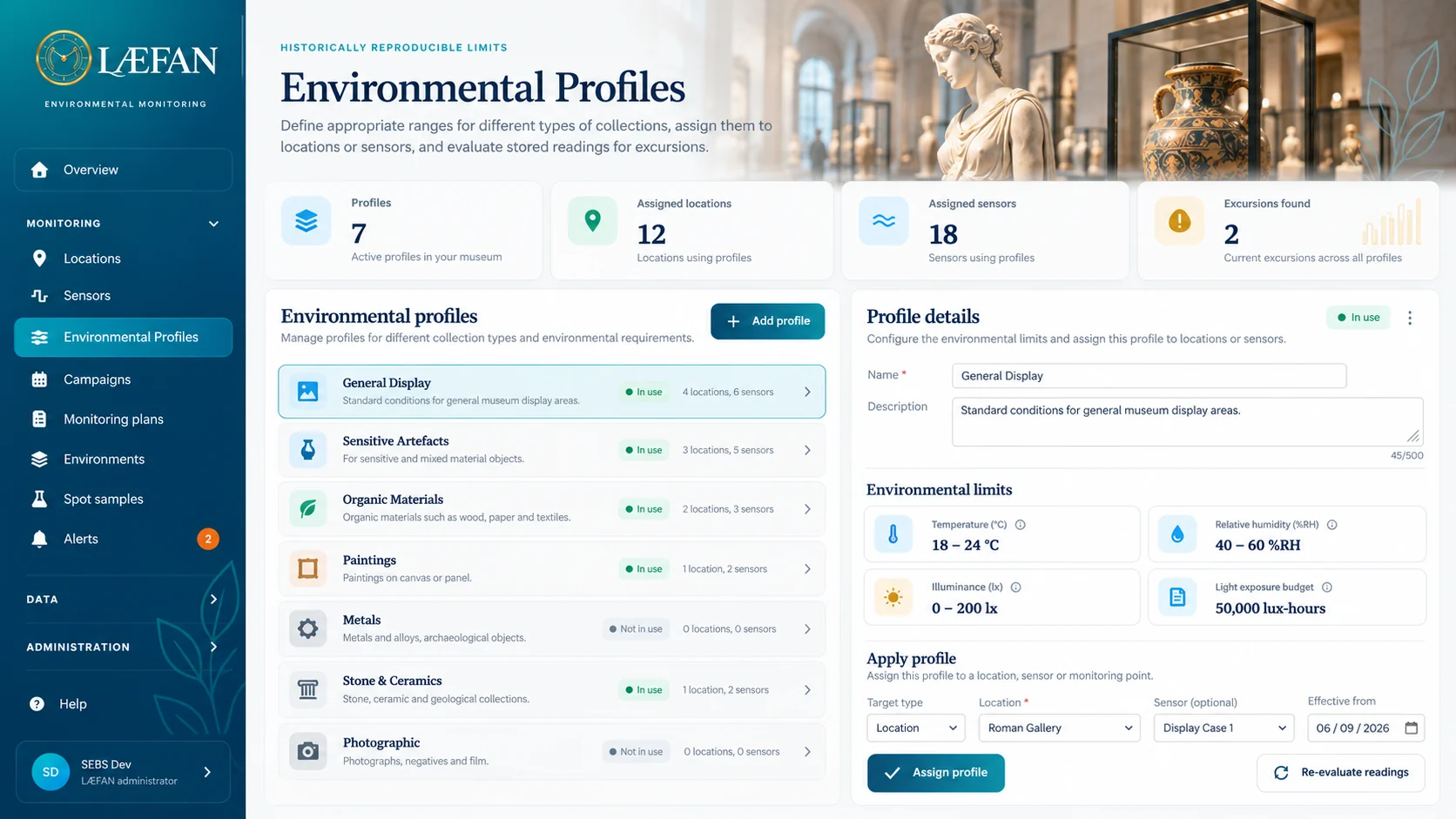
Why profiles exist
One building can contain very different environmental needs.
Paper, textiles, wood, paintings, metals, ceramics, photographs and natural history material do not share a single ideal environment. Some risks are driven by damp, some by dryness or rapid change, some by corrosion thresholds, and some by cumulative light exposure. Current CCI guidance explicitly takes a risk based and collection specific approach rather than treating one universal set point as the answer.
Identify the material or collection type and the deterioration mechanisms that matter.
Historic annual averages and normal variability may matter, especially for permanent collections.
A store, display case, gallery or temporary exhibition may justify a different monitoring context.
Material led thinking
Profiles can be useful without pretending every material has a magic number.
Paper, books & archives
Temperature affects the rate of chemical deterioration, while incorrect RH can contribute to mould, distortion and mechanical damage. Storage guidance also needs to consider the building and repository, not just sensor limits.
Wood, textiles & hygroscopic organics
These materials exchange moisture with the air. Large or rapid RH changes can create dimensional movement and stress, so stability and historic conditions can be as important as a fixed target.
Metals & archaeological material
Some metals and salts can have critical humidity thresholds below the conditions that are comfortable for mixed collections. A dedicated profile can stop those needs disappearing inside a generic room target.
Paintings & composite objects
Composite structures can contain materials that respond differently to moisture and temperature. Profiles should reflect vulnerability, construction, condition and conservation policy rather than the label on the room.
Photographic & audiovisual collections
Chemically unstable media may benefit from cooler conditions than general display areas. Separate storage zones and collection specific profiles are often more meaningful than a single museum wide rule.
Stone, ceramics & glass
Many inorganic objects are relatively tolerant of ordinary RH variation, but salts, previous treatments, decoration and mixed components can change the risk. Profiles should describe the actual object group.
How LÆFAN handles it
Make the policy visible and historically reproducible.
Relevant guidance
Standards support judgement; they do not remove it.
BS EN 15757:2010 is specifically concerned with temperature and relative humidity specifications intended to limit climate induced mechanical damage in organic hygroscopic materials. CCI Climate Guidelines and ClimaSpec similarly emphasise collection vulnerability, risk and sustainable, context specific control.