
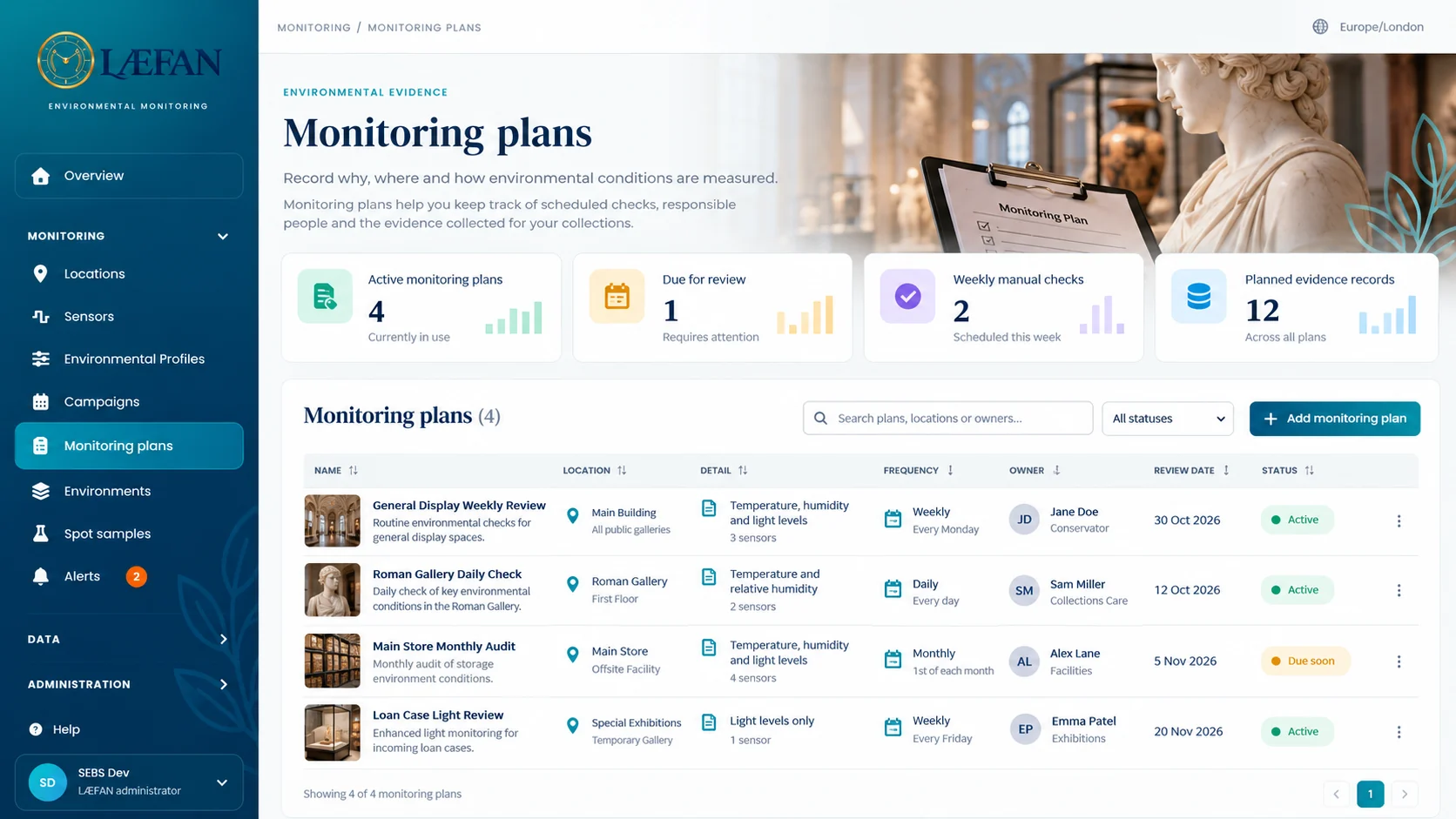
Planned monitoring
Record how the collection is meant to be monitored.
Monitoring Plans capture the purpose and routine around environmental checks. They can identify where monitoring happens, what is being checked, how often review is expected and who owns the activity. That turns an informal routine into visible evidence.
Describe the monitoring activity, frequency, location and evidence expected.
Continuous sensors and spot samples provide the observed environmental evidence.
Alerts, acknowledgements and investigation history explain how exceptions were handled.
Different evidence types
Continuous monitoring and specialist checks do different jobs.
LÆFAN keeps spot samples separate from continuous sensor data. A manual lux reading, surface temperature check, case inspection or specialist sample can therefore be retained without pretending it came from a continuously installed sensor.
Operational alerts are also separated from environmental excursions. A failed collector or stale data source should not be confused with a genuine collection condition problem.
The evidence chain
Keep enough context for the record to make sense later.
Storage & archive context
The monitoring plan sits inside a wider collections care framework.
For archive and library collections, BS 4971:2017 covers long term conservation practice. BS EN 16893:2018 addresses buildings and rooms used for storage or use of heritage collections, while ISO 11799:2024 specifies repository requirements for archive and library materials. LÆFAN contributes monitoring evidence; it does not replace the broader requirements of those standards.